

For years, “financial inclusion” has been one of those phrases that sounds impressive in policy documents but feels abstract on the ground. It is easy to quote statistics about the unbanked and underbanked; it is harder to understand what inclusion actually looks like in the everyday lives of people far from city centres.
That changed for me one December afternoon at Ichida Junction in Anambra State.
My Opay debit card had expired weeks earlier in the city, and like many people juggling deadlines, movement and life, renewing it simply was not on my list of priorities. It wasn’t urgent enough to justify the queues and traffic. But when I travelled to my hometown for the Christmas holidays, with time moving more slowly and days stretching wider, curiosity took over. If fintechs truly claim to be “banking the unbanked,” could that promise hold up in a rural setting?
I decided to find out.
Fifteen Minutes, One POS Stand, and a New Debit Card
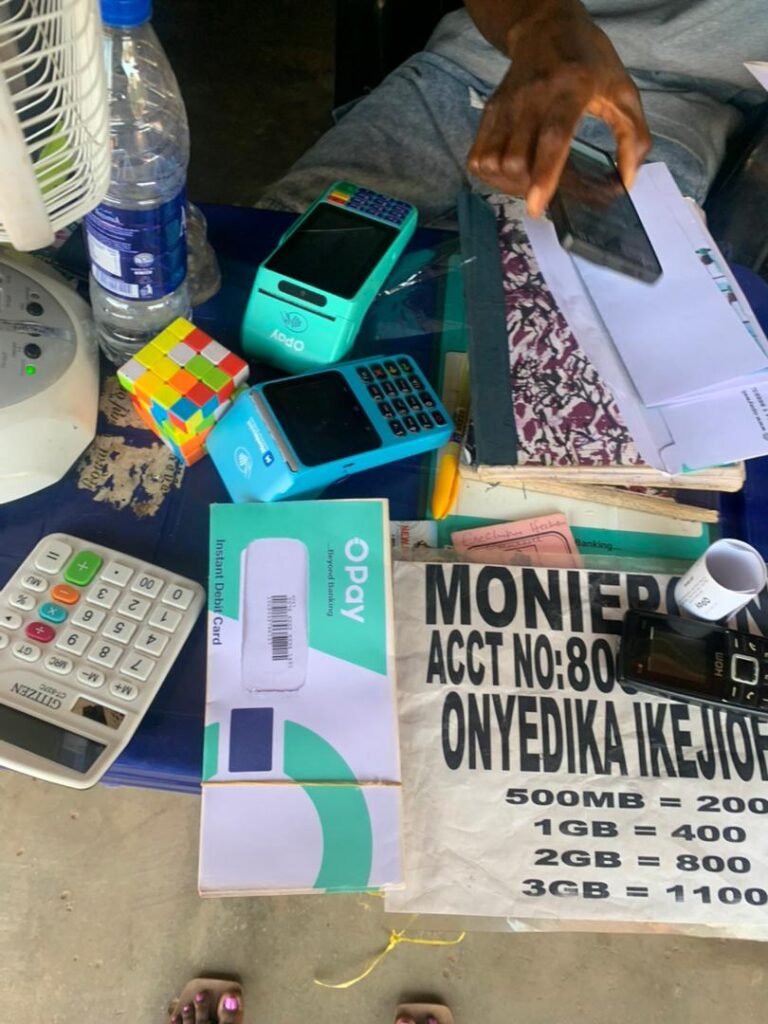
At a small POS stand run by a man who also doubles as a gas attendant, I asked a question I honestly expected to be laughed off.
“Can I renew my OPay card here?”
He said yes.
For ₦1,000, the entire process could be done right there. Before my turn came, another woman was already there for the same thing, renewing her OPay card. The process took under fifteen minutes, slowed only by unstable network connectivity. When it was done, I walked away with a freshly issued debit card, valid until 2030, completed entirely at Ichida Junction.
No bank branch. No long-distance travel. No city infrastructure.
Just a POS terminal, mobile connectivity and a fintech backend doing exactly what it promised.
As I walked home, one thought kept repeating itself… this is the quiet power of technology.
Fintech Where Banks Never Went
For decades, rural banking in Nigeria followed a predictable pattern. If you lived outside major towns, you planned your finances around absence. You travelled with large amounts of cash during festive periods because you knew there would be no nearby bank branches, no ATMs within walking distance, and no guarantees of access once you arrived.
In my case, the closest physical banks to my village are in Nnewi or Ekwulobia, both a journey, not a stroll.
Fintechs like OPay and Moniepoint have quietly redrawn that map. POS agents have become micro-branches, embedded into daily life. They are found at junctions, fuel stations, kiosks and roadside stalls. In places legacy banks never found commercially viable enough to serve, fintechs have stepped in with lighter infrastructure, lower costs and faster deployment.
What used to be a logistical risk, carrying large sums of cash into rural areas, has been significantly reduced. A debit card and a POS agent now offer access, liquidity and flexibility that didn’t exist a few years ago.
This isn’t theoretical inclusion. It’s practical, visible and deeply impactful.
South-East Nigeria and the Reality of Fintech Penetration
The South-East has long been commercially vibrant but structurally underserved. It is a region powered by traders, small manufacturers, transporters and informal businesses, exactly the demographic fintechs claim to serve.
What stands out today is how deeply embedded these services have become. POS agents are not just transaction points; they are service centres. People withdraw cash, make transfers, open accounts, resolve card issues, and now even renew debit cards without ever interacting with a traditional bank.
This depth of penetration is not accidental. Fintechs understood early that inclusion in regions like the South-East would not come through glossy branches or digital-only promises. It would come through people agents who live in the communities they serve, who speak the language, understand local rhythms and operate within existing economic flows.
That human layer is what makes the system work.
Gap Fintechs Still Have to Confront
Yet even in this success story, cracks remain visible.
The same renewal process that impressed me was slowed by unstable network connectivity. Poor broadband penetration and unreliable mobile networks still affect transaction speed, success rates and agent efficiency across rural areas. Power supply remains inconsistent, forcing agents to rely on generators or power banks. When systems go down, there is often no clear escalation path for rural users who lack digital literacy or customer support access.
There is also the question of cost. While ₦1,000 for card renewal may be acceptable to many, fees can quietly accumulate for low-income users who rely heavily on POS services for basic financial access. Transparency and fairness in agent pricing remain uneven across locations.
Financial inclusion, if it is to be meaningful, must not only exist, but must be affordable, reliable and dignified.
What Fintechs Can Do Better in Rural Nigeria
The next phase of fintech growth in the South-East and South-South will depend less on expansion and more on refinement. Investing in stronger offline-capable systems, improving agent training, standardising service fees and strengthening rural customer support channels will matter just as much as onboarding new users.
Partnerships with telecom providers to stabilise rural connectivity, as well as collaboration with local cooperatives and trade groups, could further deepen trust and reliability. Inclusion should not stop at access; it should extend to resilience.
A Quiet Revolution Happening at the Junction
What happened at Ichida Junction was not a headline-grabbing launch or a polished marketing campaign. It was a quiet, functional moment where technology met real need and delivered.
That is the kind of progress that rarely trends on social media but reshapes everyday life. Fintechs in Nigeria, especially in the South-East, are no longer experimenting with inclusion. They are living it imperfectly, yes, but tangibly. And for communities long excluded from formal banking systems, that difference is not small. It is transformative.
Sometimes, the future of finance doesn’t arrive in glass buildings or app updates.
Sometimes, it arrives at a roadside POS stand, hands you a debit card, and sends you home in under fifteen minutes.
That, too, is innovation.